
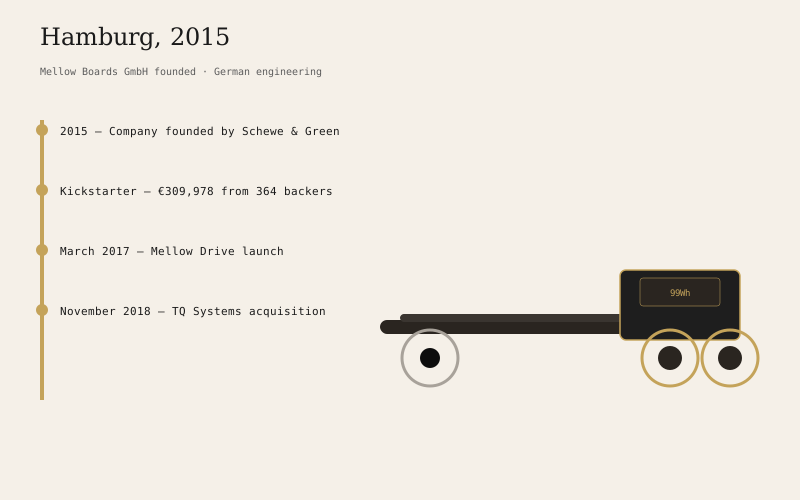
Origins in Hamburg, 2015
Mellow Boards emerged in Hamburg, Germany, in 2015 when Johannes Schewe and Kilian Green combined skate culture with electrical and mechanical engineering backgrounds to pursue a modular electric drive. The city offered access to European supply chains, engineering talent, and a growing conversation about urban mobility alternatives. Rather than positioning Mellow as a toy or a gadget, the founders framed their work as board sports extended by clean torque — a philosophy visible in campaign copy and early press demonstrations.
The company's first public inflection was not a trade show launch but a Kickstarter campaign in May and June 2015. Crowdfunding suited modular hardware: backers could see CAD renders, component breakdowns, and realistic schedule risks while committing funds toward tooling and certification work. Mellow's transparency about specifications — in-wheel motors, IP65 sealing, four modes — attracted a backer profile that skewed knowledgeable rather than impulse-driven.
Kickstarter and validation
The campaign sought €100,000 and closed with €309,978 pledged by 364 backers, a result that funded development beyond the minimum viable run. Success brought scrutiny as well as capital: delivery dates, certification, and manufacturing quality became community topics on update threads and in specialist press. Mellow's updates during this period documented engineering milestones — battery management tuning, remote pairing, water ingress testing — that later appeared largely unchanged in launch specifications.
Read the dedicated Kickstarter page for funding analysis and backer context.
Development years, 2016–2017
Between campaign close and commercial launch, the team navigated tasks familiar to first-run hardware: supplier selection, assembly line setup, compliance testing, and support infrastructure. Delay announcements were handled through Kickstarter updates — a historical record now valuable for understanding how specifications stabilised while schedules shifted. Pre-production units circulated to media and demo events, establishing Mellow's reputation for build quality relative to belt-driven competitors of the era.
Complete-board products — the Mellow Cruiser and Mellow Surfer — partnered with Buddybuddy decks while retaining the same Drive core, illustrating the modular strategy in retail form rather than DIY mounting only.
Launch — March 2017
Mellow Drive units reached backers and entered sales channels documented in contemporary sources in March 2017. Launch materials reiterated core specs: 40 km/h top speed, approximately 15 km range on a 99 Wh battery, regenerative braking, dual in-wheel motors, and a 3.9 kg drive assembly. Reviews from the period often highlighted hub motor quietness, mode differentiation, and the ability to mount the Drive on rider-owned decks — benefits that made sense to longboard commuters already invested in board feel.
TQ Systems acquisition — November 2018
In November 2018, TQ Systems — part of the TQ-Group — acquired Mellow Boards. Corporate acquisitions in micromobility often integrate IP and engineering teams into larger automotive or electronics portfolios while sunsetting consumer-facing brands or support models. Public reporting at the time framed the deal as bringing Mellow's drive technology under established industrial ownership. Post-acquisition public detail from Mellow as an independent consumer brand becomes sparse in open sources, which is why this archive treats later operational status as unverified.
Market context, 2015–2017
Electric skateboards in Mellow's formative years split into belt-driven performance boards, budget single-hub commuters, and crowdfunded experiments with uneven delivery records. European riders faced stricter urban enforcement in some municipalities than US early adopters, making credible specifications and weather sealing more than marketing fluff. Mellow's Hamburg base positioned it near automotive supply-chain culture — relevant later when TQ-Group, an electronics supplier with automotive ties, acquired the company.
Modularity was Mellow's clearest differentiator. Competitors sold integrated decks where a dead battery or obsolete controller retired the entire board. Mellow bet that riders would pay for a premium drive unit that survived multiple deck lifecycles. That bet shaped support documentation, mount compatibility lists, and community forum threads preserved in archives referenced on our sources page.
Community and backer ecosystem
Kickstarter backers functioned as an extended QA team: reporting remote pairing edge cases, asking about airline travel with 99 Wh packs, comparing hill performance against belt drives they owned. Mellow's update cadence during 2015–2017 is primary-source gold — it shows which specifications were locked early (hub dual drive, IP65 target, four modes) and which schedules slipped (mass production dates). Understanding that ecosystem prevents retroactive narrative that paints launch delays as sudden surprises; they were chronicled in public.
Complete-board buyers — Cruiser and Surfer — entered a simpler ownership path but shared firmware, modes, and battery behaviour with modular owners. Unified drive firmware reduced fragmentation that plagued other brands with unrelated hub and belt SKUs.
Legacy and research value
Even if consumer support channels are unclear today, the Mellow Drive remains a reference implementation of compact dual hub rear drive with explicit mode governance and regeneration-first range strategy. Engineers studying thermal limits of small hub motors, or historians of crowdfunding hardware, can trace documented decisions from campaign promise through launch reviews. That is why this archive emphasises specification stability: Mellow's relatively honest spec sheet makes before/after comparisons meaningful.
Hamburg as engineering home
Hamburg's port logistics, manufacturing networks, and proximity to Northern European component suppliers gave Mellow practical advantages beyond branding. Founders could iterate physical prototypes quickly, visit suppliers, and recruit mechanical and electrical talent familiar with automotive-grade process discipline — a culture that showed in IP testing narratives and structured Kickstarter updates rather than ad-hoc social posts alone.
German privacy and product compliance norms also shaped how specifications and safety themes were communicated to EU backers first, with international expansion following documented certification work mentioned in campaign threads preserved in web archives.