
Product strategy
Mellow sold the modular Mellow Drive as the core SKU and offered complete boards for riders who wanted factory integration: the Mellow Cruiser and Mellow Surfer, built with Buddybuddy decks paired to the same drive technology. All shared the historical specification set — dual in-wheel motors, 99 Wh battery, four modes, regenerative braking, IP65, 40 km/h top speed, approximately 15 km range, 3.9 kg drive weight.
This archive describes products as they were documented historically. We do not list current prices, purchase links, or availability.
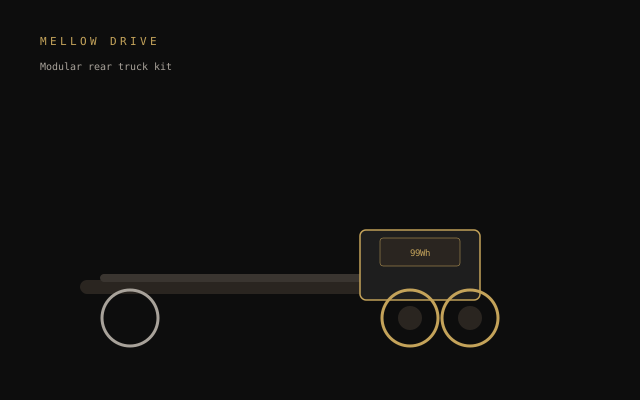
Mellow Drive
Modular rear assembly for compatible longboard decks.
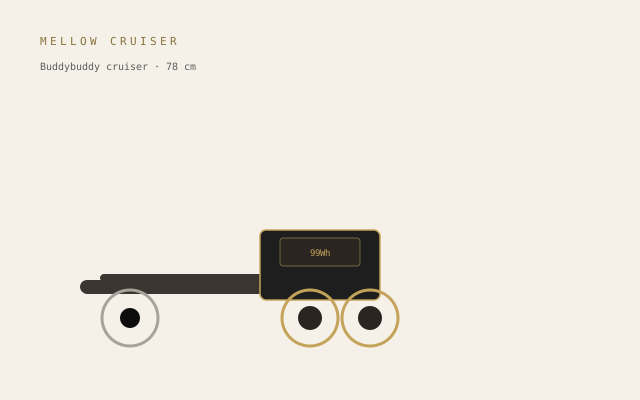
Mellow Cruiser
Complete board with Buddybuddy cruiser deck integration.
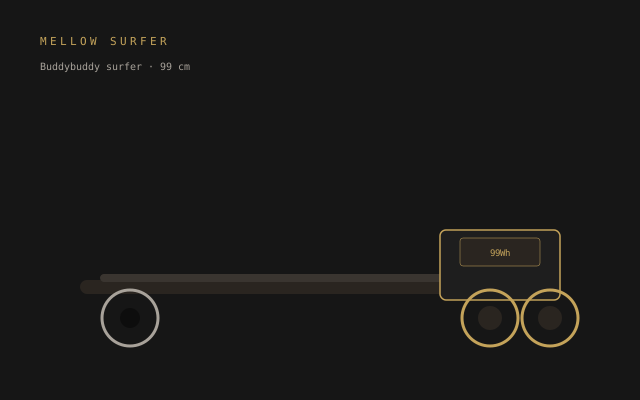
Mellow Surfer
Complete board with Buddybuddy surfer deck geometry.
Shared specifications
Complete boards versus modular
Complete SKUs reduced setup friction and ensured deck-drive pairing validated by Mellow and Buddybuddy. The modular Drive appealed to riders with existing decks and willingness to tune bushings and wheelbase. Both paths relied on the same engineering — a point Mellow emphasised in launch messaging to avoid fragmenting support across incompatible "hidden" revisions.
Post-2018 corporate ownership may have altered which SKUs remained commercially active; that continuity could not be independently verified for this archive.
Choosing a historical SKU
Modular buyers valued deck loyalty — keeping a favourite flex profile while electrifying. Cruiser buyers wanted stable commuter geometry without researching mount compatibility. Surfer buyers prioritised surf-inspired aesthetics and carving feel from Buddybuddy's shape while accepting identical drive limits: 40 km/h ceiling, ~15 km range baseline, four modes, regeneration, IP65. None of these choices altered battery or motor hardware inside the Drive — simplifying spare-part thinking for historians inventorying variants.
Retail packaging and bundle contents differed by region and batch; unboxing reports in archived reviews note chargers, remotes, and mounting kits. We do not reproduce historical price points as current offers.
Ownership experience (documented period)
Period owner communities discussed tire wear on hub wheels, remote battery replacement, and cleaning after wet rides despite IP65. Complete-board owners reported fewer mount issues; modular owners traded flexibility for setup responsibility. Support expectations were set by Kickstarter updates years before launch — an unusually long onboarding that educated buyers about mode discipline and regeneration technique before first rides.
Product line coherence
Mellow avoided the SKU proliferation that confused other brands — one drive architecture, two complete-board shapes, clear specification table. That coherence makes this archive's historical record easier to navigate than brands with incompatible hub generations sold under similar names. Researchers comparing 2017 launch materials to 2015 campaign promises find alignment on core numbers, strengthening trust in the documented spec grid reproduced across our technology pages.
Buddybuddy deck partnership detail
Buddybuddy supplied deck platforms for Cruiser and Surfer SKUs while Mellow supplied the Drive — a division of labour common in skate industry collaborations. Deck graphics, flex patterns, and concave differed; mounting interfaces were validated jointly. Owners seeking deck replacements historically needed compatibility with Drive mount patterns, not arbitrary longboard decks, unless running modular configurations with separately validated boards.
Partnership branding appeared in photography and specification PDFs from the launch window indexed under archive categories. We do not document Buddybuddy's subsequent product lines beyond Mellow pairings cited in Mellow materials.
Documenting without selling
This product section describes historical SKUs only. Absence of buy buttons is intentional: we cannot verify sellers, authenticity, or support for listings you may find elsewhere. Specification tables summarise launch-era public data for researchers and owners — not an invitation to purchase unverified hardware from third parties.
Accessories and packaging (historical)
Period unboxing reports mention chargers matched to regional outlets, remotes with mode indicators, and printed quick-start guides — contents varied by batch and market. Some backers received early-run hardware with minor cosmetic revisions documented transparently in updates rather than silent substitutions. Tracking those revisions matters for collectors distinguishing first-run from later production when serial documentation survives.
Modular owners received mounting kits sized to documented truck patterns; missing washers or incorrect torque remained common setup failures discussed in forums — product education issues rather than hidden defects when instructions were followed.
Long-term ownership outlook
Lithium aging affects all legacy Drives regardless of deck partnership. Historical owner guidance recommended storage charge levels and avoiding deep discharge cycles — still valid physics for any retired pack. This archive cannot certify remaining capacity on any specific unit offered second-hand today; treat range claims from sellers skeptically without measurement.
Warranty and support (historical framing)
Launch-period consumer brands typically offered limited warranty terms documented in box inserts — exact duration and geography vary by market and year. Post-acquisition support continuity could not be verified here. This page does not reproduce warranty text that may have expired or changed; owners should locate period PDFs in web archives if disputing historical coverage terms for a specific serial number.
Serial number tracking for modular versus complete-board SKUs helps historians correlate firmware batches documented in forum threads — another reason product pages link to archive methodology rather than anecdote alone.
Colour and graphic variants on Buddybuddy decks changed with season while Drive hardware remained stable — a common skate industry pattern confusing buyers who assumed visual refresh implied motor revision. Check period SKU documentation before inferring hardware generation from deck art alone.
Retail packaging photography from 2017 launch window shows consistent Drive labelling across SKUs — helpful when identifying third-party listings that mislabel generic hub boards as Mellow-compatible without documentation.
Historical price tiers existed at launch but are omitted here intentionally to avoid implying current offers or collectible valuation.