
Campaign results
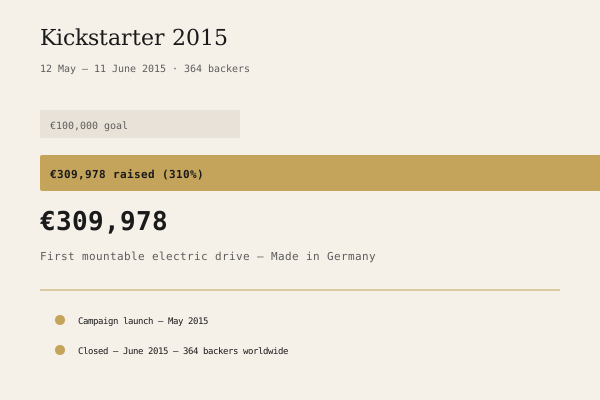
Mellow Boards ran a Kickstarter campaign in May and June 2015 with a €100,000 funding goal. It closed with €309,978 pledged by 364 backers — over three times the target — signalling strong demand for a modular, dual hub-motor drive engineered in Germany.
Reward tiers historically included Drive units and complete-board packages at prices documented in campaign archives (not reproduced here as current offers). Delivery timelines extended into 2017 as manufacturing matured — a pattern familiar to first-run hardware but intensely documented in Mellow's update stream.
What backers funded
Campaign promises aligned closely with launch specifications: dual in-wheel motors, 99 Wh battery, ~15 km range, 40 km/h top speed, regenerative braking, four riding modes, IP65 rating, 3.9 kg drive weight, 366 × 174 × 59 mm dimensions. That alignment — rare in crowdfunding — strengthened post-launch credibility when units finally shipped in March 2017.
Community and updates
Kickstarter comments and updates form a primary source for understanding engineering trade-offs during development. Backers debated delivery dates, travel battery rules, and comparison with belt-driven competitors. Those threads remain valuable for historians even when the original platform UI changes.
Lessons for hardware crowdfunding
Mellow's campaign illustrates both strengths and risks of community-funded mobility hardware: capital without dilution, passionate early adopters, but also obligation to educate non-technical backers about mode limits, weather sealing, and service expectations. The company's relatively stable spec sheet reduced bait-and-switch accusations but did not eliminate schedule pressure after funding closed.
Reward tiers and backer expectations
Campaign tiers historically bundled Drive units at early-bird pricing and complete-board packages at higher pledge levels documented in archived campaign pages. Backers weighed modular versus turnkey choices before manufacturing existed at scale — a decision few consumer products require at preorder. Mellow's educational content on mount compatibility reduced but did not eliminate post-delivery support load from mismatched decks.
International backers faced shipping and certification questions addressed in updates covering EU compliance and regional charger standards — routine for hardware but labour-intensive for small teams.
Delivery narrative
Slips between projected 2016 delivery and March 2017 launch were chronicled incrementally. Updates explained supplier delays, testing failures, and retesting — the unglamorous core of hardware. Comparing update timestamps to specification mentions shows Mellow locked core numbers early while schedules moved — a pattern distinguishing honest delays from scope creep.
Backer sentiment in comment threads ranged from frustration to defence when engineering transparency was high. That sentiment archive matters for researchers studying trust in crowdfunding mobility.
Post-campaign retail
After fulfilment, Mellow expanded beyond backer-only shipments into retail channels documented in launch-period press. Kickstarter functioned as marketing and capital, not the sole revenue channel — important for understanding scale. Exact retail partners and regions appear in contemporary reviews and press releases indexed under sources.
Numbers in context
€309,978 from 364 backers implies an average pledge materially above the minimum tier — consistent with premium hardware positioning rather than impulse gadget pricing. Triple oversubscription funded stretch goals documented in updates: tooling, testing, and initial inventory beyond bare minimum fulfilment. Raw funding totals alone understate engineering obligations accepted when stretch goals expanded scope.
Compare funding ratio to goal (≈3.1×) when benchmarking against other 2015 mobility campaigns — Mellow's outcome was strong but not an outlier among credible hardware successes with delayed delivery.
Specification promise integrity
Campaign critics often focus on delivery dates; Mellow's historical record also invites analysis of specification integrity — the degree to which shipped hardware matched promised hub dual drive, modes, IP65, and battery size. Launch reviews largely confirmed core figures, separating Mellow from campaigns that silently changed motor types or battery capacity. That integrity underpins this archive's repeated specification table.
Backer geography and communication
Kickstarter backer maps historically skewed toward EU and US urban centres with strong skate and tech communities — Hamburg campaign origin amplified German and Northern European participation. Update translations occasionally lagged English posts; researchers should note language of primary update when quoting commitments. Comment threads mixed technical questions with emotional delivery frustration — both are historical data, not noise.
Transition from backers to retail customers
Retail buyers after fulfilment faced shorter education funnels than backers who read two years of updates — increasing support load for basic mode questions documented in owner FAQs. Mellow's decision to keep specifications identical between backer and retail units avoided a two-tier product story but did not eliminate support variance by customer entry path.
Press cycle after funding
Specialist e-skate and tech press covered Mellow repeatedly between campaign close and launch — each wave resetting public expectations about delivery windows. Articles from 2016 often reiterate unchanged specs while hedging dates — a pattern confirming engineering lock-in amid schedule fluidity. Index those articles under archive categories when URLs survive in web captures.
Stretch goals documented in updates expanded manufacturing scope; researchers should read stretch goal descriptions before assuming every backer reward mapped one-to-one to final retail SKUs without revision.
Currency display in € reflects campaign origin; international backers converted mentally at 2015 exchange rates — a footnote relevant when comparing pledge totals to USD-denominated campaigns from the same year.
Final backer count of 364 is modest compared to mass-market gadgets but large for premium hardware with high unit cost — a distinction analysts often miss when comparing raw backer numbers across unrelated Kickstarter categories.
Campaign duration across May–June 2015 concentrated funding into a short window — reducing mid-campaign engineering pivot risk visible in longer crowdfunding schedules.
Goal exceedance ratio (~3.1×) remains a standard metric when benchmarking Mellow against peer campaigns in archived Kickstarter research datasets.