
Before you roll
Electric skateboards demand protective equipment and legal awareness. Laws governing powered boards vary by country, city, and path type. This guide describes historical product behaviour documented for the Mellow Drive; it is not legal advice and does not certify that riding is permitted where you are.
Inspect mounting hardware before each session if you run a modular setup. Confirm remote pairing, battery charge, and mode selection while stationary or at low speed per owner documentation from the period.
Choosing a mode
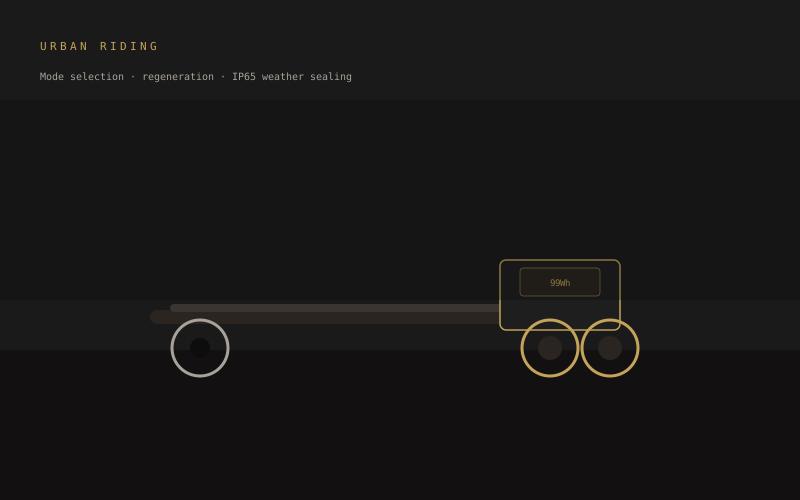
Mellow's four riding modes shape acceleration gentleness and top speed below the 40 km/h ceiling. New riders historically started in Rookie or Eco; experienced commuters used Eco for range; open-path segments might justify Pro assuming terrain and traffic allowed.
Mode affects regenerative braking feel — especially downhill. Learn braking in a flat empty area before mixing traffic and hills.
Maximising range
Published ~15 km range assumes cooperative terrain and disciplined throttle. Anticipate stops to regenerate, avoid repeated full-throttle launches, and match mode to route profile. Cold weather reduces battery performance — a general lithium trait noted in owner FAQs of the era.
Weather and IP65
IP65 rating indicated protection against low-pressure water jets and dust ingress in lab conditions — not immunity to submersion or negligent charging port exposure. Riders in wet climates still benefited versus open belt drives, but standing water and salt require cleaning and inspection per historical maintenance guidance.
Urban commuting technique
Commuters historically used Eco mode for stop-start city blocks, saving Pro for bike-lane stretches without cross traffic. Scanning for potholes mattered more on hub boards where wheel diameter and urethane were integrated assemblies — not quickly swapped soft wheels. Standing balance and foot placement adapted to accelerated rear weight; complete-board riders reported faster acclimation than first-time e-skate riders on unfamiliar belt drives.
Integration with public transit — carrying a board with a 3.9 kg rear bias — favoured riders who practiced picking up the board by the nose with drive secured, a technique shown in period demo videos.
Maintenance reminders (historical)
Owner materials recommended periodic hardware torque checks on modular mounts, cleaning charging ports after wet rides, and storing partially charged for long idle periods — standard lithium guidance. Hub tire wear indicators appeared in community forums when riders logged kilometres in abrasive urban surfaces. IP65 did not eliminate bearing service over long horizons.
We cannot verify current repair part availability; qualified skate or electronics technicians may assist owners independently.
Group riding and etiquette
Mode discipline mattered in group rides: Pro-mode acceleration gaps separated inexperienced riders quickly. Historical community norms encouraged announcing mode switches and respecting pedestrian zones — legal restrictions on powered boards vary widely and remain the rider's responsibility to research.
Learning progression
Historical owner guidance suggested progression: Rookie while learning remote finesse, Eco for daily commuting once comfortable, Pro only when terrain and traffic permitted full performance within legal limits. Skipping steps produced predictable forum posts about sudden acceleration or unexpected regeneration pull — user education issues, not mysterious defects, when modes were misunderstood.
Foot braking remained a skill on powered boards; regeneration did not remove the need to practice stopping without power in emergencies — a theme in period safety FAQs mirrored on our FAQ page.
Night and visibility
Urban commuters riding at dusk historically relied on personal visibility gear — board lights were not always integrated in Drive-era documentation the way modern integrated LED boards later adopted. Archive riding guidance treats visibility as rider responsibility independent of IP65 or motor performance.
Remote ergonomics and fatigue
Handheld remotes require consistent thumb control over multi-kilometre commutes. Period owner tips mentioned wrist straps and avoiding phone-holding in the same hand — mundane ergonomics affecting safety. Remote battery replacement intervals appeared in manuals now archived sporadically; plan for legacy remotes with reduced range if cells aged.
Carrying and storage
3.9 kg rear bias changes how boards are picked up and stored on trains or in offices. Historical demo videos show nose carry techniques reducing drive impacts on door frames. Storage temperature guidance followed general lithium recommendations — avoid hot car trunks long-term — independent of Mellow-specific marketing.
Hills, payload, and realistic range
Rider weight and hill profiles dominate range variance more than flat-ground marketing figures. Eco mode on moderate inclines historically satisfied commuters who learned route planning; repeated Pro-mode hill repeats shortened rides predictably. Regeneration on downhills returned partial energy but never fully offset climb costs — physics lesson repeated in owner forums of the period and summarised on our regenerative braking page.
Wet surfaces reduce traction regardless of IP65 sealing on electronics — riding technique must adapt faster than hardware marketing sometimes implied in generic action footage from the era.
First rides after mounting
Modular owners historically performed slow speed tests in Rookie on flat ground before commuting — verifying mount torque, remote pairing, and unusual vibrations indicating misalignment. Complete-board owners skipped mount verification but still benefited from mode progression. First-ride checklists appeared in quick-start guides now scattered across web archives referenced from sources.
Group lessons from experienced owners — documented in forums — emphasised looking over shoulder before acceleration even at Eco speeds, treating powered boards as faster-than-pedestrian vehicles in mixed traffic.
Audio cues from hub motors helped riders sense speed without staring at remote displays — a subtle skill developed over hours rather than minutes, especially when transitioning between riding modes mid-route.
Document local speed limits independently — hardware capability and legal allowance diverge in many jurisdictions.