
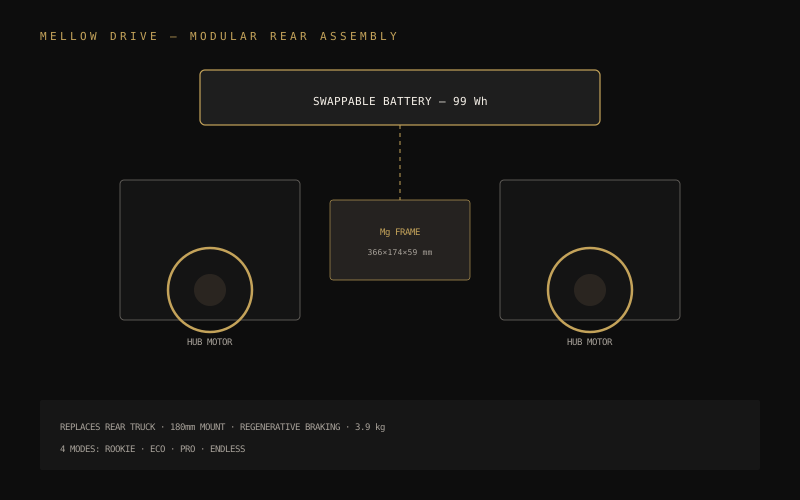
System architecture
The Mellow Drive was conceived as a replaceable rear-end module: two in-wheel motors, a 99 Wh battery, motor controllers, wireless receiver, and structural truck hardware integrated into a single assembly riders bolt onto compatible longboard decks. That architecture separated deck flex and geometry from powertrain iteration — unusual in an era when many competitors sold monolithic boards with non-swappable electronics.
Published specifications from launch-period materials converge on the following figures, reproduced here as historical documentation:
Subsystems
Mellow Drive
Mechanical integration, mounting, and industrial design.
In-Wheel Motors
Dual hub motors, torque delivery, and service considerations.
Battery
Energy capacity, range economics, and airline-limit context.
Regenerative Braking
Recovery strategy and rider technique.
Riding Modes
Eco, Rookie, Pro, and advanced profiles.
Design philosophy
Mellow's engineering choices reflected commuter realism over benchmark chasing. A 99 Wh pack sat near airline carry-on thresholds common in the period, accepting shorter absolute range in exchange for portability and weight near 3.9 kg for the drive alone. Four riding modes gave riders explicit control over acceleration curves and top speed within the 40 km/h ceiling. Regenerative braking extended practical range when riders used terrain and braking proactively rather than relying on throttle alone.
IP65 ingress protection signalled intent for all-weather urban use — rain-slick streets, curbside splashes — though no rating replaces sensible riding judgment. Dual motors improved hill starts and traction compared with single-drive setups common in budget hub boards of the same years.
Comparison context (historical)
Early e-skate market segments in 2015–2017 included belt-driven high-torque boards, single-hub budget boards, and premium integrated designs. Mellow's modular hub-drive sat between DIY flexibility and turnkey convenience. Belt drives often delivered sharper acceleration but exposed components; hub drives traded some thermal headroom for cleanliness and lower maintenance. Mellow bet that modularity would matter to riders who already owned quality decks — a bet validated by Kickstarter uptake but tested by the support burden of heterogeneous mount setups.
Electrical architecture
At launch, Mellow documented a sealed 99 Wh pack feeding dual motor controllers synchronised for rear traction. The handheld remote communicated wirelessly to select among four riding modes and to command throttle and braking inputs interpreted by firmware with regeneration profiles. Battery management responsibilities — cell balancing, temperature monitoring, over-current protection — lived inside the IP65 envelope, reducing rider-accessible maintenance but improving weather resilience versus external pack boards.
Dual motors allowed torque vectoring strategies simpler than four-wheel car platforms but more balanced than single-drive hub boards that could spin wheels on wet hills. Launch reviews noted predictable acceleration curves in Eco versus sharper response in Pro, confirming mode separation was functional rather than cosmetic — an important distinction when many competitors' "modes" were label-only.
Mechanical packaging
Fitting motors, cells, and controllers into a 366 × 174 × 59 mm volume while retaining truck mounting points required iterative CAD visible in campaign updates. Weight at 3.9 kg exceeded passive truck mass substantially — decks needed appropriate flex and mounting hardware torque. Mellow's modular philosophy pushed mechanical competence to owners; complete-board SKUs mitigated that by factory pairing with Buddybuddy decks validated for the load.
Hub wheels were proprietary assemblies — not generic longboard wheels — affecting maintenance and tire replacement workflows documented in owner materials. Bearing service and tire wear remained periodic costs even with belt elimination.
Firmware and rider interface
Mode selection, remote pairing, and low-battery behaviours were firmware-defined. Post-acquisition firmware hosting could not be verified for this archive; owners of legacy units should treat unofficial downloads cautiously. Historically, Mellow communicated update procedures through owner portals and support channels now potentially offline — another motivation for preserving methodology on the sources page.
Riding guide · FAQ · Glossary
Thermal and hill-climb behaviour
Small dual hub drives face thermal limits on sustained hill climbs — physics unchanged by marketing. Mellow's mode system reduced continuous high-current draw in Eco and Rookie, extending component life and reducing sudden thermal throttling surprises. Pro mode on long inclines could invoke controller limits documented generically in EV systems: reduced torque until temperatures stabilised. Launch reviews on moderate European urban hills generally reported adequate performance when modes matched rider expectations.
Understanding thermal behaviour explains why dual motors helped traction but did not magically eliminate physics — a nuance often lost in spec-sheet shopping comparisons between belt and hub architectures in 2016 forum debates preserved in archive references.
Serviceability boundaries
IP65 sealing and integrated pack design prioritised reliability over user-swappable cells — a trade-off common in compact drives. Owners replaced tires and bearings on schedule; battery service required qualified technicians even during the active commercial period. Post-acquisition parts availability cannot be verified here. Documenting these boundaries honestly protects researchers from assuming modular deck philosophy extended to modular battery bricks — it did not on the shipped Drive described in launch materials.
Noise, vibration, and ride feel
Hub motor architecture changed road feedback versus belt drives: some riders described a slightly damped acceleration ramp in Eco and a more direct connection in Pro. Vibration from hub assemblies depended on tire compound and pavement quality — variables independent of motor choice. Launch reviews on European cobblestones and smooth bike lanes remain useful primary texture beyond specification tables alone.
Standards and compliance (historical references)
Period materials referenced testing workflows consistent with CE-marked consumer electronics sold in the EU — exact certificate numbers appear sporadically in archived PDFs indexed under sources. Researchers should cite certificate identifiers when found rather than inferring compliance from IP65 marketing alone. Wireless remote protocols and EMC behaviour were part of the integrated product even if less glamorous than top-speed headlines in press coverage.